Comment on the article below:
Lacking any scientific expertise, these young journalists impress with their supposed investigative journalism, which is nothing more than reading headlines and rehashing old smear campaigns. Experienced journalists no longer have to soil their hands; that is left to recent graduates. They judge people they neither know nor have interviewed - people who could be their parents or grandparents and who are, among other things, far more educated than themselves.
Such juvenile bungling does not make one famous; rather, it makes one a lackey of the vile propaganda against Germanic Heilkunde.
Note: The translation of the article seems incorrect in some places, but the original German article contains many errors and false information - for example, the plural form of “Iron Rule of Cancer”.
Pilgrimage Site for the Pseudo-Cancer Healer
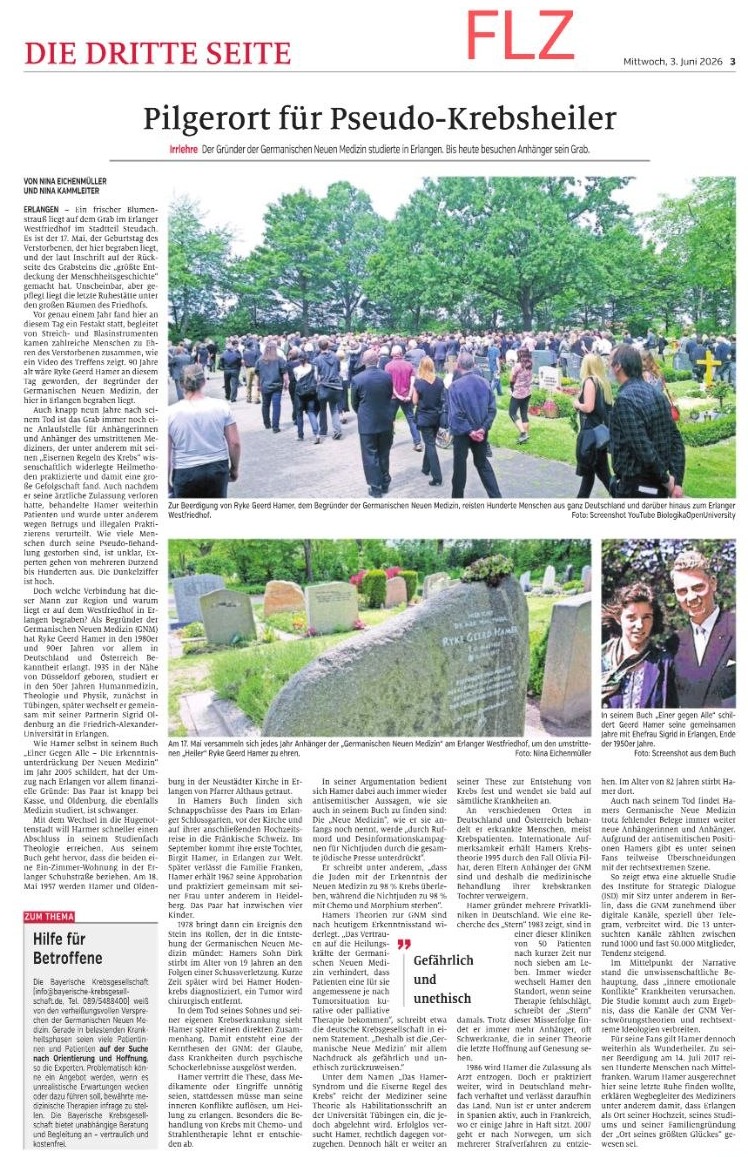 Fränkische Landeszeitung, June 03, 2026
A false doctrine. The founder of the Germanic New Medicine studied in Erlangen. To this day, followers visit his grave.
BY NINA EICHENMÜLLER AND NINA KAMMLEITER
ERLANGEN – A fresh bouquet of flowers lies on the grave at Erlangen’s Cemetery in the Steudach district. It is May 17, the birthday of the deceased who is buried here and who, according to the inscription on the back of the headstone, made the “greatest discovery in human history.” Inconspicuous but well-maintained, the final resting place lies beneath the large trees of the cemetery.
Exactly one year ago today, a ceremony was held; accompanied by string and wind instruments, a large crowd gathered to honor the deceased, as shown in a video of the event. Ryke Geerd Hamer, the founder of Germanic New Medicine, who is buried here in Erlangen, would have turned 90 on that day.
Note: Dr. med. Mag. theol. Ryke Geerd Hamer was never stripped of his academic titles!
Even almost nine years after his death, his grave remains a place of pilgrimage for followers of the controversial physician, who - among other things - practiced scientifically discredited healing methods based on his “Iron Rules of Cancer” and thus gained a large number of followers.
Note: The IRON RULE OF CANCER has never been scientifically disproven - on the contrary, it is considered well-established: The Scientific World Journal
Even after losing his medical license, Hamer continued to treat patients and was convicted of charges including fraud and illegal practices. It is unclear how many people died as a result of his pseudo-treatments; experts estimate the number ranges from several dozen to hundreds. The number of unreported cases is high. [For comparison: watch the interview with attorney Mendel]
But what connection does this man have to the region, and why is he buried at the Erlangen West Cemetery? As the founder of Germanic New Medicine (GNM), Ryke Geerd Hamer became well known in the 1980s and 1990s, particularly in Germany and Austria. Born in 1935 near Düsseldorf, he studied medicine, theology, and physics in the 1950s, first in Tübingen, and later moved with his girlfriend Sigrid Oldenburg to the Friedrich-Alexander University in Erlangen.
As Hamer himself describes in his 2005 book "One Against All - The Suppression of the New Medicine", the move to Erlangen was primarily for financial reasons: the couple was short on cash, and Oldenburg, who was also studying medicine, was pregnant.
By moving to the Huguenot city, Hamer hopes to complete his degree in theology more quickly. His book indicates that the two moved into a one-room apartment on Schuhstraße in Erlangen. In May 1957, Hamer and Oldenburg were married by Pastor Althaus at the Neustädter Church in Erlangen.
Hamer’s book features snapshots of the couple in the Erlangen Palace Garden, in front of the church, and on their subsequent honeymoon in Franconian Switzerland. In September, their first daughter, Birgit Hamer, is born in Erlangen. The family later leaves Franconia; Hamer receives his medical license in 1961 and practices alongside his wife in Heidelberg, among other places. The couple eventually has four children.
In 1978, an event set the chain of events in motion that would lead to the development of Germanic New Medicine: Hamer’s son Dirk died at the age of 19 after being shot. Shortly thereafter, Hamer was diagnosed with testicular cancer, resulting in the removal of a tumor through surgery.
Hamer later saw a direct correlation between his son’s death and his own cancer. This gave rise to one of the cornerstones of GNM: the belief that illness is triggered by psychological shock experiences.
Hamer believes that medication or surgical interventions are unnecessary; instead, one must resolve one’s inner conflicts to achieve healing.
Note: this wording comes from the ZWEISTEINs, not from Dr. Hamer!
In particular, he strongly opposes the treatment of cancer with chemotherapy and radiation therapy.
In his arguments, Hamer repeatedly makes use of anti-Semitic statements, such as those found in his book: “For non-Jews, the New Medicine,” as he initially calls it, “is suppressed by character assassination and disinformation campaigns by the entire Jewish press.”
Among other things, he writes, “that 98% of Jews survive cancer thanks to the principles of the New Medicine, while 98% of non-Jews die from chemotherapy and morphine.”
According to current scientific understanding, Hamer’s theories on GNM have been disproved. [Note: This is a brazen lie.]
“Relying on the healing powers of Germanic New Medicine prevents patients from receiving curative or palliative therapy appropriate for their specific type of tumor,” writes the German Cancer Society in a statement. “Therefore, ‘Germanic New Medicine’ must be strongly rejected on the grounds that it is dangerous and unethical.”
Under the title ‘The Hamer Syndrome and The Iron Rule of Cancer,’ the physician submitted his theory as a postdoctoral thesis to the University of Tübingen, but it was rejected. Hamer unsuccessfully attempted to challenge the decision in court. Nevertheless, he continued to stick to his theory on the origin of cancer and soon applied it to all diseases.
He treats patients, mostly cancer patients, at various places in Germany and Austria. Hamer’s theory of cancer gained international attention in 1995 due to the case of Olivia Pilhar, whose parents, following GNM and Hamer’s advice, refused medical treatment for their daughter, who was suffering from cancer.
Hamer founded several private clinics in Germany. As an investigation by “Stern” magazine in 1983 revealed, in one of these clinics, only seven out of 50 patients were still alive after a short time. Hamer repeatedly changes locations whenever his therapy fails, “Stern” reported at the time. Despite these failed attempts, he gains more and more followers - often seriously ill people who see his theory as their last hope for recovery.
In 1986, Hamer’s medical license is revoked. Yet he continues to practice, is arrested several times in Germany, and subsequently leaves the country. From then on, he operates in Spain, among other places, as well as in France, where he spends several years in prison. In 2007, he moves to Norway to evade several criminal proceedings. Hamer dies there at the age of 82.
Even after his death, Hamer’s Germanic New Medicine continues to attract new followers despite a lack of scientific evidence. Due to Hamer’s anti-Semitic views, there is some overlap between his followers and the far-right movement.
For example, a recent study by the Institute for Strategic Dialogue (ISD), based in Berlin among other locations, shows that GNM is increasingly being disseminated through digital channels, particularly Telegram. The 13 channels examined had a combined total of around 1,000 groups and nearly 50,000 members, with numbers on the rise. At the heart of the narrative was the unscientific claim that “internal emotional conflicts” cause illness
Note: This wording does not origin from Dr. Hamer! It seems that most of the “research” on Telegram has focused on the ZWEISTEINs ...?
The study also concludes that GNM channels spread conspiracy theories and far-right ideologies.
To his fans, however, Hamer is still a miracle healer. Hundreds of people traveled to Middle Franconia for his funeral on July 14, 2017. When asked why Hamer chose this particular place as his final resting place, those close to him explained that Erlangen – where he was married, attended university, and founded his family – was the “place of his greatest happiness.”